Back to blog
Education
May 27, 2026
The Feminine Mistake
Why Feminism is Not Responsible for Women in the Workforce
Feminism Cannot Be Radical
One of the talking points that is very common on the new right, a talking point that I certainly agree with, is that women are created to be conforming creatures. Women are rarely, if ever, the radicals of their day. Rather, we drift more into the ditch of schoolmarming, Karen-ing, and tone policing. We like to enforce the social customs of our time, because it is within those social customs that we find safety and security. We are resistant to change because change brings risk and uncertainty. And because we have little to no ability to physically protect ourselves, we much prefer the safety of our own known environment.
Men, we say, are the ones who built the West. The uncertainty and promise of the unknown beckons to the masculine spirit and affronts the feminine. Men enjoy the adventure and discovery, the feeling of walking away from the politeness and security of society and taming the wild. Men are the ones who build ships, armies, and rockets. They lead revolutions and draft constitutions. They are martyred for theological doctrines, both orthodox and heretical. Men dream of independence, while women desire protection and security.
Rousseau famously argues that the most important thing for a woman is that she has a good reputation, and the most important thing for a man is that he does not. In other words, a woman is most valuable when she is loved and adored by society, while the most valuable men are the ones who are hated by society. Now, when Rousseau made this claim he was, amongst other things, referring to the sexual purity of the sexes specifically, and so consequently, I would disagree with him. However, there is a grain of truth in his statement. Women, in general, are more likely to gravitate towards feelings of acceptance than men are. Sometimes for the better, sometimes for the worse. Women will generally err in the ditch of too much conformity, while men will err on the other side…at least in normal times.
However, when these same members of the new right turn around and begin to address the sins of feminism, they very quickly make women the radicals and men the traditionalists. Feminism, as it is commonly conceived of, was an incredibly radical upheaval in the social fabric. More than that, the movement has been led almost entirely by women at great cost to those women’s safety, and reputation. How could something as radical and risky as feminism come about if it was entirely led by the more conforming sex? If one is to argue that that is indeed the case, then one must provide a very good reason for why nature was suddenly so blatantly disregarded.
In our day, of course, it is much safer socially to identify as a feminist, but that was most definitely not the case in 1800s Massachusetts. And yet, it must be the case that many women left the safety and security of the patriarchy to strike out on their own in order for us to be where we are today. Feminism used to be more socially taboo than eugenics or membership in the KKK. And yet here it is. The question must be asked: how did it come to be that a country of normal, socially conforming women suddenly radicalized and then so completely and immediately conquered the patriarchy?
In order to reconcile the character of women with the nature of feminism, at least one of them must be re-evaluated. My purpose here is to look specifically at the entrance of women into the workforce, and ask how exactly it came about that women participate alongside men at an almost equal rate of employment. I will be arguing that feminism was an almost negligible factor when it came to the entrance of women into the labor market.
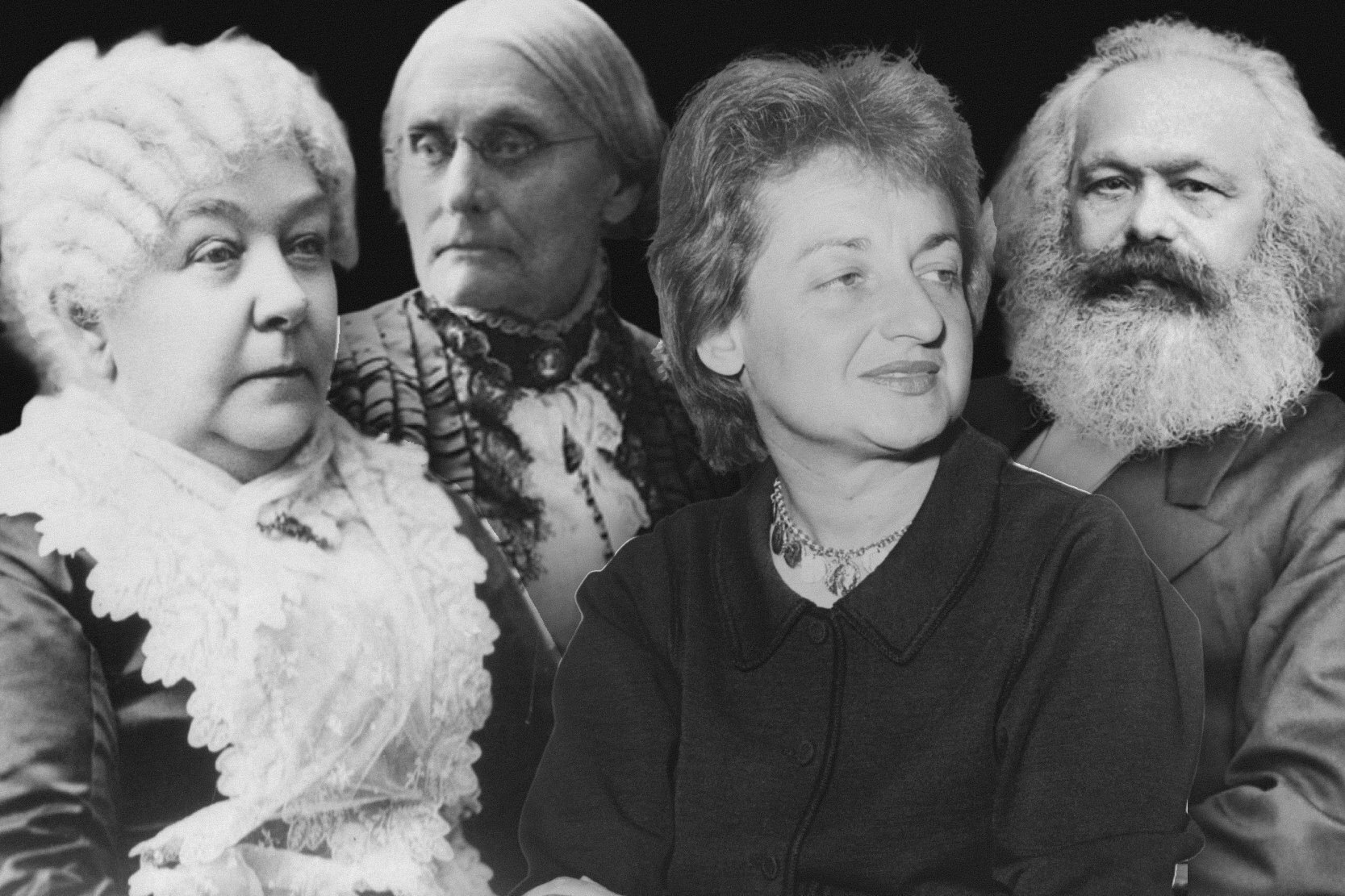
In the year 2025, women made up 47.1% of the workforce in the United States, and there is not a feminist alive who would not take credit for a number so close to 50%. Now, if she is an educated feminist, she will more specifically attribute the “victory” to Betty Friedan, and second wave feminism. Friedan published her book, The Feminine Mystique, in 1963, which argued that, in order for women to find purpose and satisfaction, she needed to enter the workforce alongside men. The book itself was immediately popular and is attributed to sparking the social revolution of second wave feminism.
If we are to believe these educated feminists (that Friedan’s book, published in 1963, was the initial catalyst behind second wave feminism and the entrance of women into the workforce), then surely such a thing would be easily observable from American census documents. One would expect to find a significant increase of female participation in the workforce throughout the 1960s up until, perhaps, the 80s and 90s. So let us give that a try.
Let us examine the sample years of 1948-1998. Throughout those fifty years, we will find a very steady increase of women flooding the job market. In 1948 women made up 28.1% of the workforce, and by 1998 they made up 46.3%. That is not an insignificant increase. Since 1998, the number has remained relatively steady up until our own day. Thus far, nothing too odd stands out.
However, if we break up that time period into 10-year increments, we will notice an interesting phenomenon. From the 1948-1958, the female workforce saw an increase of 6.5%. From 1958-1968, the increase was only 4.2%. From 1968-1978 the increase was 4.5%, 1978-1988 saw a 3.6% increase, and from 1988-1998 there was only a 1.4% increase. What we should note is when the most significant percentile increase occurred. It was during the 1950s, that bastion of traditional housewifery, that the American workforce saw the largest statistical increase of employed women. Notice that this is all before Betty Friedan published her book arguing for women in the workforce. After her publication in 1963, there was absolutely no spike in female employment. Not only was there no spike, there was an actual 2% decrease of women seeking employment. In other words, there was still an increase throughout the 60s, only the increase was far less than it had been throughout the 50s. While Friedan’s book may have been popularly received, sparked national conversation, and provoked many a protest, the U.S. Bureau of Labor Statistics itself does not notice any observable change in the immediate aftermath of the book’s release.
This certainly begs the question whether or not Friedan, or second wave feminism in general, did much to affect the rate of female employment. The increase was there before the protests were there. If “feminism” did not cause the rate of employment of women in the 50s, can it even be said to have cause the rate of female employment in the 60s and onward?
Another oddity here is the nature of Friedan’s argument. Friedan spends much of her time arguing from precedent. The basic premise of her book is that women used to be in the workforce, and that they used to be happy. Now, it would make sense if Friedan’s argument was based upon an early 1940s statistic. Since the U.S. was embroiled in WWII, large portions of the male population were overseas, and consequently American women swarmed the workforce to fill the vacant jobs. Instead, she argues from 1930s women’s magazines. Her claim is that many of the short stories portrayed confident, independent, career driven women. She concludes that it must have been more socially acceptable in the 1930s for a woman to want a more masculine career. This makes even less sense. What could have been going on the 30s to have made Friedan believe that America used to be a more feminist friendly culture? What was it that Friedan wanted to return to?
Karl Marx’s Explanation
The Communist Manifesto, written by the infamous Karl Marx, was first published in the United States in 1888. While Marx flits quickly from subject to subject, he does briefly touch upon the topic of women in the workforce. Knowing communists to be what they are, it will come as no surprise to you that he is in favor of women working (this is in keeping with his broader desire to dismantle the nuclear family). The surprise will rather come in the unusual way he argues his point.
“Modern industry has converted the little workshop of the patriarchal master into the great factory of the industrial capitalist… Differences of age and sex have no longer any distinctive social validity for the working class. All are instruments of labour, more or less expensive to use, according to their age and sex.” - Karl Marx, Communist Manifesto.
Much like Friedan, Marx does not argue from what should be, but from what already is. He does not make grand overtures to the wonderful contribution women would make to his utopian society. Rather, he blames capitalism (rather harshly) for the erasure of sexual distinction within the working class.
“The bourgeois claptrap about the family and education, about the hallowed correlation of parent and child, becomes all the more disgusting, the more, by the action of modern industry, all family ties among the proletarians are torn asunder, and their children transformed into simple articles of commerce and instruments of labour.” - Karl Marx, Communist Manifesto.
Now Marx is being tricky, if not downright deceitful, here. He insults the capitalist, rather soundly, for his treatment of women and children. Capitalism has reduced these precious familial relationships simply into commodities ranked according to their attendant prices, or so the argument goes. The trick is that Marx himself has no objection to the erasure of distinction between man and woman, parent and child. He simply minds that the capitalist objects to communism on the grounds that it dissolves the nuclear family, when capitalism has already murdered the family of the working class. Ultimately, it boils down to a simple tu quoque. Marx would like to do to the women and children of the bourgeois what the bourgeois has already done to the proletariat. Furthermore, he resents the hypocrisy of the blame being placed exclusively at his own feet.
Regardless of my feelings about Marx and his solutions, in justice to him, we should at least consider the possibility that he was observing a real phenomenon amongst the working class. We can ask ourselves whether or not it is true that the dawn of industrialism saw a large increase of women entering the workforce.
As we work through the following statistics you will have to bear with me since the 19th century was not as full of surveys as the present day. Most of the work here is a game of piecing together what we can.
In 1820, 58% of the Northeast industrial cotton manufacturing workforce was adult women. They made up 11% of the wool industry, 2.4% of the clothing industry, and 27.7% of all other manufacturing industries across the Northeast. Of course, you should note that this is not the same as women making up 58% of “the labor force,” as this statistic excludes agricultural work etc.
Additionally, you should note that this statistic comes from the dawn of the industrial era when these industries were quite small. In the following years, as we will look at momentarily, the percentages drop. This should not necessarily be read as a decrease in the total number of women working, as the number of factories were growing, as was their need for employees.
An 1850 MA census records that women of all ages comprised 29.1% of the cotton manufacturing workforce, 7% of wool manufacturing, 18.3% of clothing, and 45.6% of all other manufacturing work. In 1860, across the entire United States, women of all ages comprised 40.7% of the textile manufacturing industry, 33.5% of clothing, and 25.8% of the rest. The numbers are relatively similar to that of 1890 when it was discovered that women over the age of fifteen filled 32.2% of textile manufacturing jobs, 34.3% of clothing, and 33.5% of all other industrial manufacturing jobs.
With something like this there are an innumerable number of factors at play, and it will be impossible to address them all, though I will attempt to address those I consider most relevant. However, it should be handed to Karl Marx that there were a significant number of working-class women who had been swept into industrial work for causes that had nothing to do with communism. Additionally, I would like to point out that it had nothing to do with Friedan’s second-wave feminism. All this begins well over a hundred years before Friedan argues that housewives will find liberation in the man’s world of the great “workforce.” The first statistic even takes place almost thirty years before the Seneca Falls Convention. Women had not even thought about asking for a vote yet, and yet they were working thirteen-hour workdays for 3 dollars a week, living in boarding houses far away from the rule of their fathers.
Catherine Beecher, Abolition, and Immigration
Catherine Beecher, sister of Harriet Beecher Stowe, published Women’s Profession as Mother and Educator, With Views in Opposition to Women’s Suffrage in 1872. In it, Beecher tackles the issue from a very different point of view. Throughout the 19th century, the U.S. saw an influx of 20 million immigrants. The heaviest wave hit in the 1840s, of course, with the Irish Potato Famine. You will remember from earlier the rapid decrease in women’s employment between 1820 and 1850. Following that, the 1860s saw the Civil War and the abolition of slavery. While many slaves stayed relatively put, there was still a large influx of freed blacks moving north in the aftermath of the war.
Beecher points out that, because the Northeast had never really seen slavery take root, it had always had a much more democratic culture than the South. While in Europe a lady may be skilled in some simple household labors, the majority of her attention was towards luxury. Beecher says, “America is the only country where there is a class of women who may be described as ladies who do their own work. By a lady we mean a woman of education, cultivation, and refinement, of liberal tastes and ideas, who, without any very material additions or changes, would be recognized as a lady in any circle of the Old World or the New. The existence of such a class is a fact peculiar to American society, a plain result of the new principles involved in the doctrine of universal equality.”
The lack of slavery in the Northeast helped this conception of lady to remain. In the South, there were no “ladies” who did not possess slaves, and no woman in possession of slaves did her own housework. Thus, the North was able to hold a high view of the profession of “homemaking” while the more aristocratic South saw such work as slave-like.
Similarly, the European immigrants flooding the country came from heavily aristocratic countries. They came from a world where you were born into a class, that class dictated your work, and that work never changed.
“In England, the class who go to service are a class, and service is a profession; the distance between them and their employers is so marked and defined, and all the customs and requirements of the position are so perfectly understood, that the master or mistress has no fear of being compromised by condescension, and no need of the external voice or air of authority. The higher up in the social scale one goes, the more courteous seems to become the intercourse of master and servant; the more perfect and real the power, the more is it veiled in outward expression—commands are phrased as requests, and gentleness of voice and manner covers an authority which no one would think of offending without trembling.
But in America all is undefined. In the first place, there is no class who mean to make domestic service a profession to live and die in. It is universally an expedient, a stepping-stone to something higher; your best servants always have some thing else in view as soon as they have laid by a little money; some form of independence which shall give them a home of their own is
constantly in mind. Families look forward to the buying of landed homesteads, and the scattered brothers and sisters work awhile in domestic service to gain, the common fund for the purpose; your seamstress intends to become a dressmaker, and take in work at her own house; your cook is pondering a marriage with the baker, which shall transfer her toils from your cooking-stove to her own.
Young women are eagerly rushing into every other employment, till feminine trades and callings are all over-stocked. We are continually harrowed with tales of the sufferings of distressed needle-women, of the exactions, and extortions practiced on the frail sex in the many branches of labor and trade at which they try their hands; and yet women will encounter all these chances of ruin and starvation rather than make up their minds to permanent domestic service.” - Catherine Beecher, Women’s Profession as Mother and Educator, With Views in Opposition to Women’s Suffrage.
Effectively, the sudden increase of freed slaves and working-class European immigrants created the sudden need for a rapid social stratification where there had not been one previously. Suddenly the idea of housework being slave-coded, or low class was thrust upon the northern American women at the same time an opportunity to work elsewhere was presented.
Another census shows that in 1900, 14% of all native born white women were employed in some form of “gainful employment” which was only slightly lower than the 19% of all foreign-born white women engaged in “gainful employment.” The highest percentage was the Negro women, 43% of whom were involved in gainful employment. But, despite native born white women being the lowest statistic, they still held the highest number of jobs at 1,771,966. This survey does not record the variety of occupations held by these women, and so it is somewhat difficult to declare definitively that the Negro women and immigrant women held the domestic work in greater proportion to the native-born white women. However, if we are to trust Catherine Beecher’s firsthand account, as I am inclined to do, the native-born white women tended to prefer those factory jobs that were more in keeping with women’s work generally, but did not doom one to the social status of “housemaid.” At the very least, it is an interesting hypothesis.
“‘I can’t let you have one of my daughters,” said an energetic matron to her neighbor from the city, who was seeking for a servant in her summer vacation; “if you hadn’t daughters of your own, may be I would; but my girls are not going to work so that your girls may live in idleness.”
It was vain to offer money. “We don’t need your money, ma’am; we can support ourselves in other ways; my girls can braid straw, and bind shoes, but they are not going to be slaves to anybody.’”
- Catherine Beecher, Women’s Profession as Mother and Educator, With Views in Opposition to Women’s Suffrage.
Great Depression and World War II
Again, I will acknowledge that I am skipping many steps here, but if you will allow me to jump forward another forty years, we will find ourselves at the dawn of the Great Depression. Before 1940, the majority of working American women were single. Generally, girls worked until they were married and then possibly took up work again once their children were somewhat independent, if at all. However, in 1940 married women suddenly flooded the workforce in larger numbers than the single women. Throughout the Depression, women entered the workforce at twice the rate of men. There were several factors here. One is the nature of women’s work. The majority of women were working in either domestic or educational work. Additionally in many manufacturing jobs, female wages were still set at almost half that of men’s, thus, making women more desirable commodities than that of men.
In 1920, women comprised 23.6% of the workforce (about 8.3 million women), and by 1930, they held 27% of all jobs (about 11 million). Notice that the 1920 statistic is taken at the very end of WWI and the 1930 number is from the beginning of the Great Depression. During WWI, women obviously entered the workforce to fill the jobs left by the enlisted men. But it was not until the Depression that men and women seem to have actually competed with one another for jobs.
There are two ways of looking at this initial competition. Most want to emphasize the hostility the women faced (in the Depression) for taking jobs from men, their decreased wages, and the lack of female-specific unions that lead women to be more mistreated as employees than men. All of that is true. However, the flip side that I would also like to consider is the advantage such a lack of legal protection gave women during a time of economic crisis.
Most of the women entering the workforce in the 1930s were married women. This means that they were not the breadwinners of the home, instead, they were looking for a supplementary income. As employers realized that women were cheaper workers than men, women actually had something making them competitive. It was not until later, after the Equal Pay Act in the 1960s, that civil rights laws needed to be put in place to demand that a woman’s female-ness may not be considered in a job interview. Before it was law that women had to be paid the same as men, women had much better odds of competing with men for the same jobs.
In 1930, 30% of all employed women worked in domestic or personal service, and out of all women employed in professional work, 75% were teachers or nurses, with many women also working clerical jobs. By 1940, 30% were clerical workers, 20% worked in factories, 20% in domestic service, 10% in professional work (teachers and nurses), and 10% in social work. Women also held 7% of all jobs in the automobile industry, and 25% of jobs in the electrical industry.
Because women seemed to be faring better than men, or at least unhelpfully competing with the men, “working women” began to be a stigmatized thing. Please note I am not saying that with any sort of bitterness or resentment towards anybody involved. I am merely pointing out that, until now, the idea of a woman working a factory job had been in no way taboo. This was because, for one, the country was not in an economic depression, and for two, until now it had been mostly single women waiting for a husband and then gladly retiring. Now, however, married women felt themselves called upon to be a helper to their husband financially and found themselves instead putting their husbands out of work. This seems to be the first moment that women working began to dismantle the unity of familial unit at a large scale. The 1932 Federal Economy Act prohibited more than one family member from working government jobs, in an attempt to subdue the marital competition, and force families to rely on a single income. This act extended to every form of government job, including librarians and teachers (jobs traditionally held by women).
Then, suddenly, on December 7th, 1941, Japan bombed Pearl Harbor and the very next day we joined WWII. Like in WWI, the enlisted men left behind a completely open job market. Within a year, the US government pivoted from trying to discourage women from finding jobs to suddenly plastering images of Rosie the Riveter all over town and singing cute wartime jingles.
While other girls attend their fav’rite cocktail bar,
Sipping dry Martinis, munching caviar,
There’s a girl who’s really putting them to shame,
Rosie is her name...
All the day long, whether rain or shine,
She’s a part of the assembly line.
She’s making history,
Working for victory,
Rosie (Brrr)* the Riveter.
Keeps a sharp lookout for sabotage,
Sitting up there on the fuselage.
That little frail can do,
More than a male can do,
Rosie (Brrr)* the riveter.
Rosie’s got a boyfriend, Charlie.
Charlie, he’s a Marine.
Rosie is protecting Charlie,
Working overtime,
On the riveting machine.
When they gave her a production “E”,
She was as proud as a girl could be.
There’s something true, about red, white and blue
About Rosie (Brrr)* the Riveter.
About Rosie (Brrr)* the Riveter.
Ev’ry one stops to admire the scene,
Rosie at work on the B-Nineteen,
She’s never twittery,
nervous or jittery,
Rosie (Brrr)* the riveter.
What if she’s smeared full of oil and grease,
Doing her bit for the old Lend-lease,
She keeps the gang around,
They love to hang around,
Rosie (Brrr)* the riveter.
Rosie’s buys a lot of war bonds,
The girl really has sense,
Wishes she could purchase more bonds,
Putting all her cash,
Into national defense.
Senator Jones, who is “in the know”,
Shouted these words on the radio,
Berlin will hear about,
Moscow will cheer about,
Rosie (Brrr)* the riveter.
Rosie (Brrr)* the riveter.
-Redd Evans and John Jacob Loeb, Rosie the Riveter.
Women were no longer obstacles to the workforce; they were the beating heart of the workforce. By the end of the war, women held 36.1% of all American jobs. The war ended in 1945, by 1948 the female employment number had dropped to 28.1%. There seems to have been an initial and very short withdrawal of women, due to returning veterans, but a steady increase ever since then.
Interestingly enough, before the Great Depression single women were employed at much higher rates than married women. I already mentioned that married women first outpaced single women during the 40s, but they continued to outnumber single women through the 50s, 60s, and 70s. All this would seem to suggest that the domestic, suburban image we have of the 1950s housewife is informed more by Friedan’s description than by real historical fact.
The Myth of Feminism
My purpose is not to reform any unfavorable impression anyone may have of feminism and its effects. Betty Friedan certainly had a large effect on the American workforce. I did not go into tracing the movement of women between jobs (things like women’s entrance into managerial work), because that was not my purpose. But I do grant that feminism did much to alter certain aspects of women working. My point is that, while feminism may have broken down certain barriers within the workforce, it did not push women into the workforce.
There is an extreme lack of clarity on the right, specifically amongst those of us who don’t like feminism, on what the solution is. Most of the time the talking point gets reduced down to “get women out of the workforce.” I am merely pointing out that, since it was not an ideological commitment to gender equality that gave women jobs, then there is no reason to expect that an ideological commitment towards the patriarchy will push women out. Like in the Great Depression, it is completely feasible (and normal in certain moments of national economic crisis like our own) for a family to be ideologically aligned with the idea that the husband should be the financial supporter of the home, but where circumstances make it such that the cost of living requires a dual income. Furthermore, like in the Depression, as more families choose to live off two incomes, the marketplace becomes far more competitive, making it harder and harder for other families to live off of a single income. As women currently make up almost 50% of the workforce, our economy is not in a position to handle a mass withdrawal of half its workers. Regardless of what you may say about HR ladies and public-school teachers, they would not be the only ones affected.
I would argue that there were three major factors that lead to the large number of women in the workforce, each of which must be analyzed separately.
1. The first is the “off-shoring” of women’s work into the factories. Large portions of our nation’s economy (what is classified as “the workforce”) is really just a reimagining of what used to be women’s work. Things like textile manufacturing, clothing manufacturing, and food production all used to make a significant portion of an “unemployed” woman’s schedule. Butter churning used to be the wife’s work, and now it is done in a factory. To the man (or woman) who wants to argue that women should not work at all, you are also arguing that butter churning is now the work of men and machines. The same thing would go for dress making, sock knitting, etc. The industrial revolution has unburdened women of a massive amount of housework. Now women either need to leave the home to perform those same tasks or refrain from those tasks completely. One could suggest the new homesteading movement as a possible solution, since it does attempt to de-industrialize the house and return large amounts of work to women. That particular topic needs a much larger conversation, but I will briefly note that it is not a very economic solution. Traditionally women milked cows because it was the frugal thing to do, but nowadays poor people don’t have family cows. Homesteading provides no practical solution to the traditionalist family that is trying to make ends meet. If single income, rural families are the only holy answer, then piety is not for the poor.
2. The second is the social stigma that comes from a woman performing her own housework. It is not the case that America was the only country to undergo this pressure, rather we were uniquely unexposed to such a pressure, at least at our founding. For centuries Europe had lived in a world where the domestic arts were relegated to the servant-class. The difference was that, because they actually had a servant class, it was simply an assumed distinction. America, in its democratic nature, was extraordinary in that it refrained from stigmatizing housework for so long. It has virtually never been the case that any woman of education cooks her own meals. However, the sudden influx of low class, uneducated women flooding the Northeast and looking for employment suddenly created a competitive market for women surrounding jobs associated with status. At the same time, the industrialization of the Northeast removed many of the more time-consuming tasks from the plates of women.
3. Thirdly, there is the question of the interference of the American government in the free market. From attempting to prevent women from outbidding men for jobs during the
Depression, to propagandizing women back in during the war, to mandating equal pay in the 60s, to criminalizing sexual discrimination (also in the 60s), the federal government has been extremely involved in the conversation for the last eighty years; sometimes pulling women out of the workforce and sometimes nudging them back in. Karl Marx was right to point out that it was industrialized capitalism that began the breakdown of the nuclear family by pulling women and children into the labor market. This is not to say that we should use the state to enforce a Marxist economic doctrine; that would be a cure worse than the disease itself. However, we will need to ask whether some government action to limit or redirect female participation in the workforce (whether or not the market demands it) will be necessary. As things currently stand, with almost 50% of the job market being women, we require a clear pathway out that goes further than a majority ideological commitment to the patriarchy. There is no historical precedent that internal commitments alone will take away the economic stressors that push families towards a dual income lifestyle. When we do see dips in female employment, they seem to be largely due to external, physical factors including government policy.
I believe each of these three factors beg three individual questions that need to be thoughtfully answered.
1. What defines the appropriate work for a woman? Is it the type of work she is doing, or is it the place wherein she does the work, or is the fact that she is being paid? In other words, if we assume two women are of equal familial status (both married with children in school), which is more of a feminist: the woman who works as an employee at a local home goods store, or the woman who works mostly from home as a realtor?
2. What distinguishes social rank for the homemaker? This is perhaps the most pressing question for those who would like to argue for an American aristocracy, or for a new elite. What do you want the women to do? If you really want a European style aristocracy, then that necessitates female servants to do your wife’s work. It also necessitates your wife suddenly not doing that work. So, what should she be doing? The question is less pressing for those of us who want something quieter, more akin to the Founding. But even for the most anti-aristocratic, egalitarian, anti-feminist (if such a thing exists), the modern middle class still begs the question. Your average suburban mother, armed with a toaster and a washing machine, is as much a noble-woman in her material possession as Martha Washington. It is a basic question of stewardship. When a woman only needs to work five hours a day in order to keep her family clothed and fed, what should she do with the rest of her day? Is gainful employment an option for her?
3. How “free” is a godly free market? Given that our economy cannot handle the shock that 77 million women leaving would produce, how do we slowly rectify the situation in a way that does not make everything way worse? Suppose over the next 50 years the majority of Americans adopt a very anti-feminist, pro-patriarchy mindset. To reiterate my earlier point, that does not necessitate a mass-exodus of women from the workforce. 1860s Northeast America was incredibly pro-patriarchy compared to our own day, and still employed a massive number of women. If your goal is to remove women from the workforce, either completely or just at a large scale, you are going to have to restructure quite a bit of American industry and economy. To adjust Marx’s point, in a completely free market, where employers are allowed to employ women at significantly lower wages than men, it is completely true that human sin can manipulate the market such that men and women have to compete with one another. Should we trust the American public to refrain from forming a competitive labor market between the sexes on the basis of their inner commitments alone? Or is there a place for government incentives, legislation, and propaganda in order to encourage the nuclear family?
Conclusion
When America first began its journey of industrialization it posed a complex ethical and philosophical question to the American people about the nature of femininity and masculinity. I do believe that the initial reaction of the American public was in the wrong direction, but I also think the stakes were low enough and the information scarce enough that it was not a sinful response but an innocent mistake. However, as the decades rolled on and that initial reaction was proved to be foolish, I believe the spirit of Mammon took over. Instead of rectifying a small blunder, Americans doubled down on what had already happened. The family continued to be slowly torn apart as husbands and wives competed with one another in an unglamorous race to the bottom. Then, in 1963, after women were a solid fixture of the office, Friedan published The Feminine Mystique that provided women with a feminist mythology to justify what had already been done. Before Friedan, no woman had thought of her employment as a fulfilling thing. It was commonly agreed upon that these women were caught up in an un-enchanting rat race. Friedan only offered up the possibility that it could be enchanting if only the nature of their jobs were different. She didn’t put women in the workforce; she merely told them that they should like it.
Feminism is only the first obstacle to overcome if we are to rebuild the traditional nuclear family unit. And, specifically within the conversation of women’s work, feminism is really only a mental obstacle for many women. Feminism is the lie that ultimate fulfillment is found in a career. But if a woman, who has a career, comes to the conviction that a career will not fulfill her, she will not find herself suddenly married and with seven children. She will still be single, still have rent due, and still have time she needs to fill. Again, I am not arguing that feminism is not a problem, I am merely pointing out that it is one of many, and that if we want to truly revive the family, those other problems need to be examined and then very carefully answered.
Sources
B F R west library nber working paper series. https://www.nber.org/system/files/working_papers/w0795/w0795.pdf.
“Celebrating Women’s History Month with a Look at Women in the Labor Force.” U.S. Bureau of Labor Statistics. https://www.bls.gov/blog/2021/celebrating-women-s-history-month-with-a-look-at-women-in-the-labor-force.htm.
Statistics of women at work. https://www2.census.gov/library/publications/decennial/1900/women-at-work/women-at-work-p2.pdf.
Technical note labor force, employment, and unemployment, 1929-39: Estimating. https://www.bls.gov/opub/mlr/1948/article/pdf/labor-force-employment-and-unemployment-1929-39-estimating-methods.pdf.
“Women in the Labor Force.” U.S. Bureau of Labor Statistics. https://www.bls.gov/cps/demographics/women-labor-force.htm.