Back to blog
Education
April 1, 2026
The Resurrection and Education
The lordship of Jesus Christ is a present and active reality. The Church is not devoted to the memory of an inspiring religious figure or striving to put into practice a way laid down long ago by a sage. Christ reigns now. His word is living and active, and all the sons of men are beholden to him. Education is always the shaping of men and women to live in the world as it is; thus, all pedagogy is the fruit of some metaphysic. One must implicitly or explicitly answer the question "what is the world?" before one sets out to educate. And Christians gladly, gratefully, and triumphantly affirm that the world was recreated on Easter morning and that all things cohere now in the risen Christ, Son of God and Son of Man.
The world is not a closed system with wheels and gears just spinning away. The world is not an accident, anomaly, or illusion. Rather, the world is the handiwork of the Triune God, spoken into being and upheld by his loving and gracious providence. It echoes with his laughter and shines with reflected glory. The divine word which upholds it is the same word that took on flesh and dwelt among us, and whom we have seen in Holy Scripture. That Word was crucified for sinful men and rose again in glory, and by his light we see light.
In hopes of constraining a piece which might otherwise tend to sprawl, here are three particular ways in which the Resurrection of Jesus of Nazareth defines the shape of Christian education.
First, the Resurrection is the reason why the created order does not slide into nothingness.
As St. Athanasius discusses in On the Incarnation, Adam's sin not only condemned all his heirs to death, but also to corruption and unravelling. The created order began to spin away into nothingness. How could anything persist cut off from the source of its life and being? Form and matter threatened to decay, to dissipate. The Incarnation of the Word did not only accomplish the justification of the elect, but it also redeemed the created order from bondage to decay (Rom. 8:21). The Incarnation cannot be separated from the Resurrection in significance or potency. Bethlehem and Calvary are two points on the same line, and they form the axis upon which the world turns. If Christ is not raised, then the created order itself has no coherence (Col. 1:17-20). This does not mean mere moral degeneracy, but unthinkable breakdowns in the rational order in creation. The architecture of the world is grace, the laws of logic are personally upheld by the loving God, because God so loved the world that he gave his only begotten son.
Second, as an event which took place in space and time, the Resurrection vindicates the study of space and time.
The work of God in redeeming the world did not take place in the translunar realm or by means of spiritual action alone. The Word took on man's nature—here in this created space-time—and as man, he was pierced and put in the ground. As man, he left the graveclothes behind and walked out into the sunlight of a world made new. Easter morning is the encore to God's pronouncement of creation's goodness in Genesis 1. In other words, stuff matters. Our Creator God walked the earth and worked with his hands and told stories about farmers and sheep and normal stuff. And now he is resurrected and ascended to the Father's right hand, the rightful king of earth and heaven. This is his world, and we are his people. How can we not love this world that he made, that he entered into, this arena where he defeated death and Satan, cleansing it with his blood?
Paul tells us in Romans 1 that the invisible attributes of God are clearly seen in this wild and woolly world, which he made and which he upholds with the word of his power. As such, this world is truly charged with the grandeur of God, and it summons us to muster all our ingenuity and courage in seeking it out. Man as zoologist is invited to see the handiwork of God in elephants and hummingbirds, as astronomer he watches the slow dance of stars and planets straining his ear for the music of the spheres, as historian he reads the story of God in the lives of men, as mathematician he chases down the patterns of loving-logic with nets made of numbers, and so on in all the areas of knowledge. The end of education is men and women who know God, as he has revealed himself in the face of Jesus Christ and in the created order, and who can articulate that knowledge in the midst of a world bought with the blood of Jesus.
All things cohere in Jesus Christ, or else they fly apart and dissipate into nothingness.
Third, those united to Christ are raised with him, and thus in Christ man's authority as King and Priest of creation is restored.
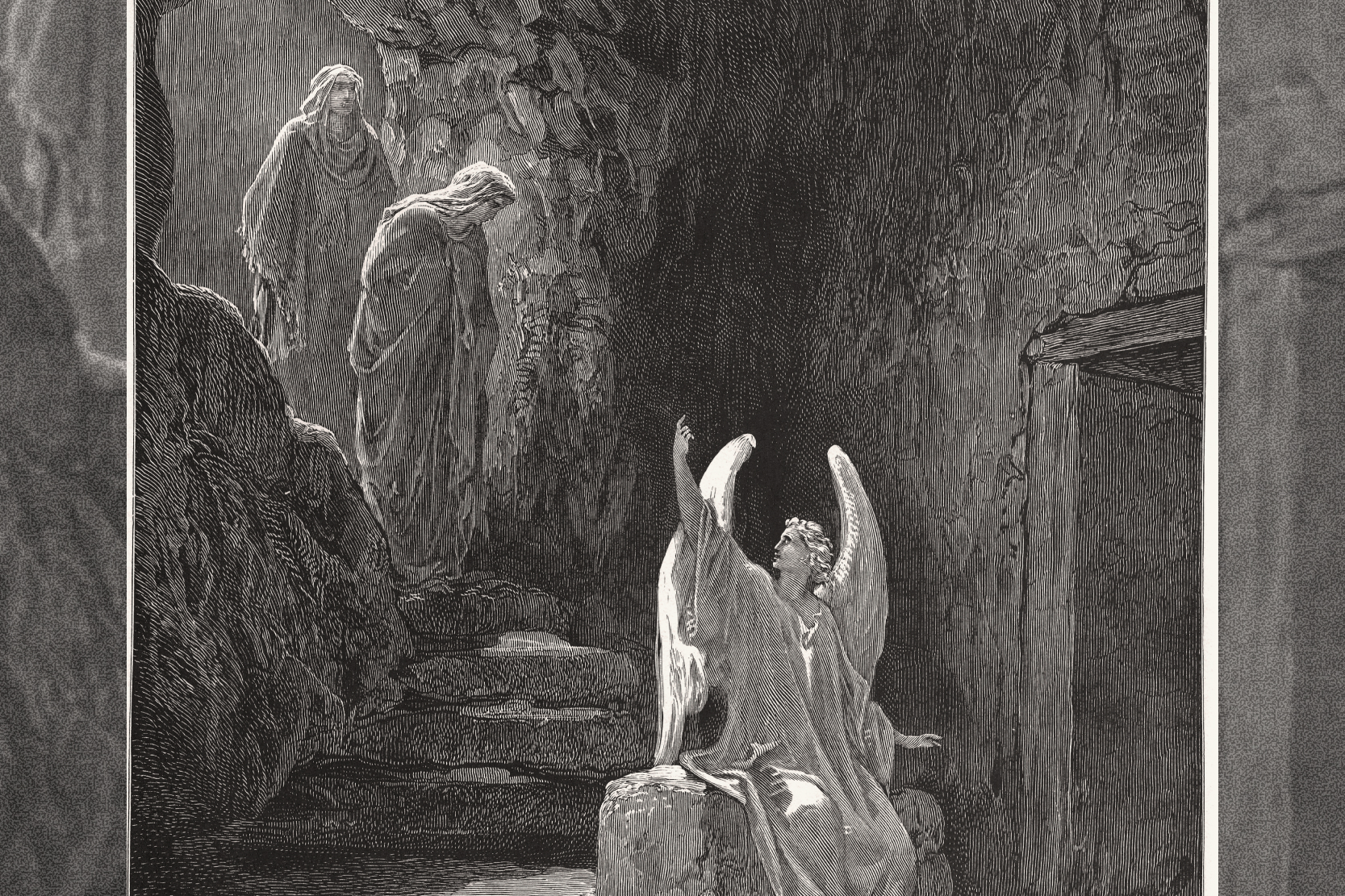
Adam was the Gardener-King of earth, beloved of his Father in Heaven. He was given the task of naming, of bringing to word the intricacies of Creation. God made the tiger, but the task of tiger-exposition was left to man. Nothing in creation has speech except man, and thus man speaks for all creation. He is the priest, offering to God the collected praises of the cosmos now put to word by his skill and wisdom. But in the Fall, man's authority in the garden of God was forfeit. He was driven out and made a dirt-scratcher rather than Poet-Gardener-King. For centuries, man was in exile and his throne empty or occupied by devils. But on Easter morning, when Mary Magdalene encounters the risen Christ, she mistakes him for a gardener. And so he is: the Second Adam, the rightful Poet-Gardener-King of Creation. His resurrection and ascension to God's right hand lifts man's human nature to the place of authority and power. By no virtue of our own, but only insofar as we are joined by grace through faith to the Son of God, we are restored to our position as Poet-Gardener-Kings of creation, every man under his own vine and fig tree. As such, we have work to do. The animals are not all named yet. The harmonies of creation are yet unarticulated. We have forgotten much, and there is much more still to uncover. Ours is the business of giving voice to creation, in Kepler's words, of using every sense for perceiving and every tongue for declaring our Maker's praises. This is true because our Lord rose from the dead on the third day, and we rose with him.
Conclusion
All things cohere in Jesus Christ, or else they fly apart and dissipate into nothingness. "He who does not gather with me, scatters," our Lord says. So those in the business of Christian education are equipping the sons of Adam and the daughters of Eve to wield the authority which the risen Christ bestowed on them. That authority was won in the realm of space and time, and thus it is exercised in space and time, so let us then be up and doing. The kindness of God is seen nowhere more clearly than in the resurrection joy of Easter morning, but in the light of that great kindness, we have eyes to see the myriad kindnesses that accompany it: in bread and wine and word and song and trees and stars and birds and beasts. This world in all its groaning glory belongs to Jesus, and so do we. Let us rise up and build.
Apply to Greyfriars Hall.